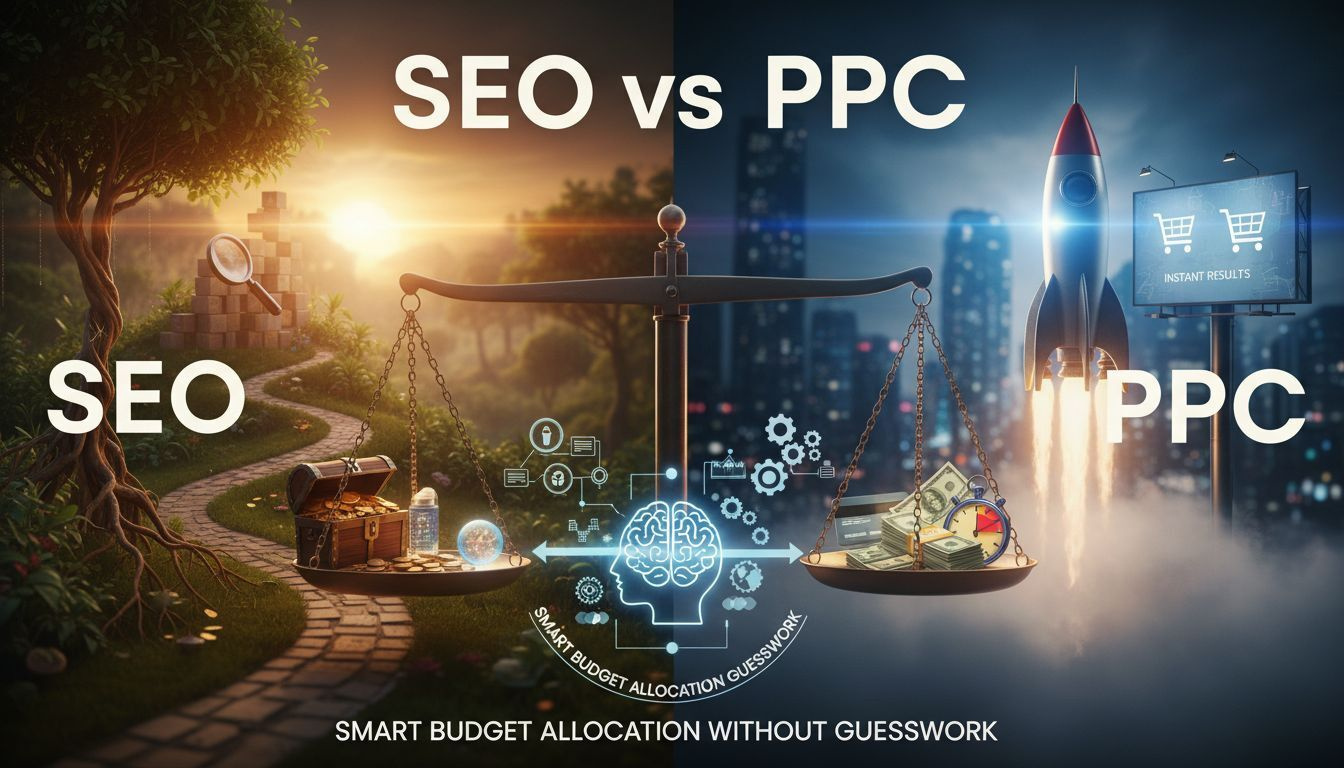
SEO vs PPC: Smart Budget Allocation Without Guesswork
SEO vs. PPC: How smart businesses allocate their digital marketing budget executes like a tightrope walk—balance, precision, and speed matter. The decision isn’t binary; it’s a dynamic portfolio decision that changes with market signals, seasonality, product maturity, and internal capabilities. In this guide, you’ll see concrete frameworks, real-world examples, and actionable steps to optimize a budget across search engine optimization and pay-per-click advertising. Expect clear trade-offs, measurable outcomes, and a plan you can execute in weeks, not months.
Introduction to the Budget Dilemma
You know the tension: SEO builds durable reach, PPC delivers immediate impact, and both require resources. Budgets aren’t limitless, and mispriced bets cost time, opportunity, and revenue. The objective is to maximize long-term value while achieving near-term wins. The best marketers treat SEO and PPC as a single engine with two pistons—pulling in distinct directions yet driving the same vehicle forward. The practical effect: allocate funds to where they pay off today and compound value over time, while keeping a disciplined testing cadence.
Framework for Allocation
Start with a simple, repeatable framework that translates data into decisions. Use three axes: potential ROI, time to impact, and maintenance cost. Map channels on a two-by-two grid: short-term impact versus long-term value, and cost to maintain. Then adjust monthly as signals shift. This isn’t a set-it-and-forget-it approach; it’s an adaptive process grounded in metrics, not vibes.
Key decision criteria
- ROI trajectory: expected return over 90 days, 180 days, and 12 months.
- Stability: how resilient are results to algorithm changes or seasonality?
- Scale potential: capability to add or remove campaigns without friction.
- Cost efficiency: cost per qualified lead or per revenue dollar generated.
- brand-building value: long-term equity from content, links, and audience trust.
Best-Fit Options
Below are 5 concrete options you can apply, each with pros, cons, and selection criteria. The aim is to build a balanced portfolio, not to chase a single channel’s fantasy ROI.
Option A: SEO-First with PPC as a Demand Amplifier
- Pros:
- Compounding traffic from evergreen content and technical SEO.
- Lower long-term marginal cost per visitor compared to PPC.
- Better user trust signals and higher click-through for branded queries.
- Cons:
- Requires steady content production and technical fixes; benefits accrue slowly.
- Algorithm updates can disrupt rankings; maintenance intensity is ongoing.
- Selection criteria:
- Website portfolio with multiple WordPress sites and client sites
- Ability to publish high-quality content at scale using AI-assisted workflows
- Existing SEO maturity: technical foundation, internal linking, content gaps
- Trust signals:
- Case studies showing 3–6x traffic lift after 6–12 months
- Technical SEO audits improving Core Web Vitals
Option B: PPC for Rapid Validation and Seasonal Demand
- Pros:
- Immediate visibility; fast feedback loops on messaging and pricing.
- Granular measurement by keyword, ad copy, and landing page.
- Ideal for product launches, promotions, and geographic testing.
- Cons:
- Costs escalate with competition; margins can erode if not controlled.
- Creative fatigue requires constant refresh; optimization is ongoing.
- Selection criteria:
- Sales cycle that benefits from short win opportunities
- High-margin products or services where CAC can be absorbed
- Strong landing page optimization and attribution model
- Trust signals:
- COGS and margin analysis showing profitability from PPC campaigns
- Loss of impression share tracked during peak periods
Option C: Hybrid Model with Data-Driven Budget Guardrails
- Pros:
- Combines the durability of SEO with the agility of PPC.
- Guardrails prevent runaway spend while preserving experimentation.
- Cons:
- Requires robust attribution and data governance.
- Cross-channel optimization complexity can increase setup time.
- Selection criteria:
- Attribution maturity: UTM tagging, CRM integration, and analytics hygiene
- Resource capacity to run concurrent SEO content sprints and PPC campaigns
- Trust signals:
- Attribution model that shows mutual uplift between channels
- Monthly budget utilization reports aligned to targets
Option D: Content-Driven SEO with AI-Generated Content Acceleration
- Pros:
- AI-assisted content creation speeds up publishing while maintaining quality controls.
- Scalable for WordPress sites, agencies managing multiple clients, and content teams.
- Cons:
- Quality assurance is non-negotiable; AI outputs require human editing.
- Uncertain long-term alignment with evolving search intents if not guided by strategy.
- Selection criteria:
- Content strategy centered on buyer intent and keyword clusters
- Systems to publish and update articles across multiple WordPress sites
- Trust signals:
- Published content with documented optimization steps and internal linking maps
- Analytics showing sustained organic traffic growth from long-tail keywords
Option E: Multi-Client Agency Playbook for Managing Numerous WordPress Sites
- Pros:
- Economies of scale by centralizing SEO and PPC management for multiple clients.
- Standardized templates, reports, and dashboards increase velocity.
- Cons:
- Complex governance; risk of resource contention across clients.
- Needs a mature onboarding and client education program.
- Selection criteria:
- Agency capability to publish SEO content across many WordPress sites
- Systems for auto-generating reports and publishing content at scale
- Trust signals:
- Client retention and expansion metrics; expansion into new services
- Operational metrics showing reduced time-to-publish and faster approvals
Actionable Tactics for Immediate Wins
Put these into practice this quarter to tighten control, prove value, and set up for scale.
- Audit and align attribution: map touchpoints from ad click to SEO-assisted conversion. Align dashboards so both channels show uplift.
- Implement a pacing plan: allocate 60% of new budget to SEO improvements and 40% to PPC tests, then adjust by performance signals.
- Content sprints anchored to cluster research: publish 4–6 high-quality articles per month; reuse assets across sites for efficiency.
- AI-assisted content with human guardrails: seed topics, review outputs, and ensure factual accuracy and brand voice before publishing.
- Landing page experiments: run parallel PPC experiments on high-intent pages and optimize based on conversion data; mirror improvements on SEO landing pages over time.
To illustrate the approach, consider a mid-market software company with a portfolio of client sites and WordPress-based properties. They started with SEO content upgrades targeting long-tail keywords tied to their core product features. Over nine months, organic traffic rose 78% and qualified leads grew by 34%. PPC campaigns focused on seasonal promotions and competitor-intent keywords, achieving a 22% reduction in CPA after aggressive negative keyword management and landing page optimization. The blend yielded a sustainable revenue lift while keeping paid media costs under control.
Message Architecture for Stakeholders
Translate the budget plan into a narrative that resonates with executives and marketing peers. Focus on risk, return, and operational readiness.
- Risk: SEO volatility from algorithm changes; PPC bidding competition and click costs.
- Return: Long-term traffic, brand equity, and near-term revenue from PPC experiments.
- Operational readiness: Content pipelines, optimization routines, and cross-team collaboration.
Practical storytelling tips
- Lead with a concrete KPI: “We expect a 20% lift in qualified leads from SEO-based content by Q3.”
- Show a 12-month plan with quarterly milestones and a budget guardrail.
- Provide a transparent measurement approach, including attribution and sampling methods.
In-Depth Analysis: Data-Driven Decision Making
Numbers don’t lie; they reveal what actually moves the needle. The most effective marketers maintain a dashboard that tracks traffic, conversions, cost per acquisition, and time-to-value by channel. They frequently revisit keyword intent shifts, content performance, and landing page conversion rates. A robust plan includes:
- Keyword strategy: prioritize high-intent terms with clear purchase signals; use a mix of head terms for visibility and long-tail terms for conversion.
- Content quality controls: ensure accuracy, readability, and structured data; deploy interlinking to strengthen topical authority.
- Ad copy discipline: test value proposition, call-to-action, and creative formats; pause underperformers quickly.
- Automation: leverage AI to draft outlines and meta tags while assigning editors to verify accuracy and tone.
In practice, the smart combination reduces wasted spend and accelerates learning. A B2B SaaS client running a dual SEO and PPC program saw incremental revenue growth when SEO content targeted highly specific pain points while PPC tested pricing and feature bundles. The synergy came from aligning the two channels around a shared buyer journey map and a shared content calendar. When a PPC campaign produced a strong signal for a hot term, the team translated the insight into an SEO content brief, accelerating evergreen pages that eventually captured the same intent at a lower cost per click over time.
As highlighted in market research, when SEO and PPC data are fused, you often observe a multiplier effect: improved quality scores in PPC due to better landing page relevance and longer user dwell times from higher-quality content. This is not magic; it’s the result of disciplined execution and continuous iteration. A well-tuned content engine can publish articles across all client sites, automate insights, and publish optimized content to WordPress platforms in 1 click via AI-enabled workflows.
According to descriptive name or website name, the research demonstrates how AI-driven publishing accelerates content lifecycle, enabling agencies to manage multiple WordPress sites with consistency. The takeaway: leverage automation to free up human resources for strategic tasks and quality assurance. The combination preserves quality while increasing throughput, creating a scalable model for both SEO and PPC investments. The narrative is not purely theoretical; it’s grounded in how teams operate today and the measurable gains they achieve when content, ads, and optimization converge.
Case Studies: What Real Teams Do
Case study one shows a digital agency that remapped its client budget by consolidating SEO program management under a centralized playbook. They reduced the average cost per qualified lead by 28% within six months while expanding content output by 40%. The agency used AI-assisted content generation to scale across multiple WordPress sites, then deployed rigorous human review to maintain brand voice and factual accuracy. The SEO gains began with technical fixes, moving into content gaps, and eventually securing higher-quality backlinks through outreach and community engagement.
Case study two examines a retailer adjusting its mix during a peak season. PPC campaigns captured last-minute demand spikes, while SEO content reinforced product category pages with updated buying guides. The combined effect: a 15% lift in revenue during the peak quarter and a 12% decrease in overall customer acquisition cost. The lesson is simple—don’t abandon SEO for a fast season; instead, bake seasonality into your content calendar and align paid efforts to complement it.
Case study three demonstrates a multi-client agency deploying a scalable publishing engine. They built a centralized dashboard that tracks performance across all WordPress sites, with automated briefs, content calendars, and weekly optimization sprints. Results included faster time to publish, improved content quality, and higher client satisfaction scores. The model shows how technology-enabled processes unlock efficiency without compromising the human expertise that ensures relevance and trust.
Common Pitfalls and How to Avoid Them
Every marketer hits speed bumps. Here are frequent missteps and practical remedies:
- Overinvesting in SEO without a content plan: Build a content calendar anchored to buyer intent and product features; avoid publishing clutter that dilutes authority.
- Ignoring mobile and core web vitals: Prioritize technical SEO and conversion-focused experience; slow pages kill both organic and paid performance.
- Letting PPC cannibalize SEO: Ensure keyword strategies are complementary, not duplicative; coordinate bidding strategies and content themes.
- Underestimating the human factor in AI use: Maintain editorial oversight and quality controls; AI should augment, not replace, judgment.
Quotes That Help Frame the Decision
“The best marketing pays for itself over time, but only if you invest in the right mix of durable SEO and disciplined PPC testing.” — Marketing Leader, Industry Benchmark
Final Plan: A 90-Day Kickoff
This is the practical blueprint you can implement now. It’s designed to be deterministic, not speculative, and it assumes access to a content team, a PPC manager, and analytics instrumentation.
- Audit and baseline: complete a full technical SEO audit, content gap analysis, and PPC performance review. Establish a baseline for organic traffic, estimated monthly revenue from SEO, and current paid metrics.
- Budget guardrails: set a 60/40 split (SEO/PPC) for new investments in the first 90 days, then adjust based on results and seasonality.
- Content engine setup: launch AI-assisted topic generation with editorial supervision; publish 4–6 articles per month across client WordPress sites; implement internal linking maps.
- Landing page optimization: run 3–5 concurrent PPC experiments on high-intent pages; replicate positive changes to SEO landing pages over time.
- Attribution harmonization: implement consistent UTM schemes, CRM integration, and cross-channel dashboards so SEO and PPC insights reinforce each other.
- Review cadence: weekly optimization huddles, bi-weekly reporting, and a 90-day strategy review to recalibrate budgets and priorities.
The path toward balanced success is clear: build durable SEO assets while maintaining the agility to seize demand with PPC. The magic happens when you align content, ads, and measurement so they move together, not in parallel tracks. You’ll see a predictable rhythm: SEO compounds traffic and trust; PPC delivers revenue acceleration and learning; together they form a resilient, scalable engine for your business.
In practice, the real kick is in execution. You must test, measure, and iterate—then institutionalize what works. The framework above is not a magic wand; it’s a disciplined approach to allocate budget where it earns dividends, now and into the future. The market shifts, competitors adapt, and buyer behavior evolves. Stay nimble, stay data-driven, and stay committed to a path that blends reliability with ambition.