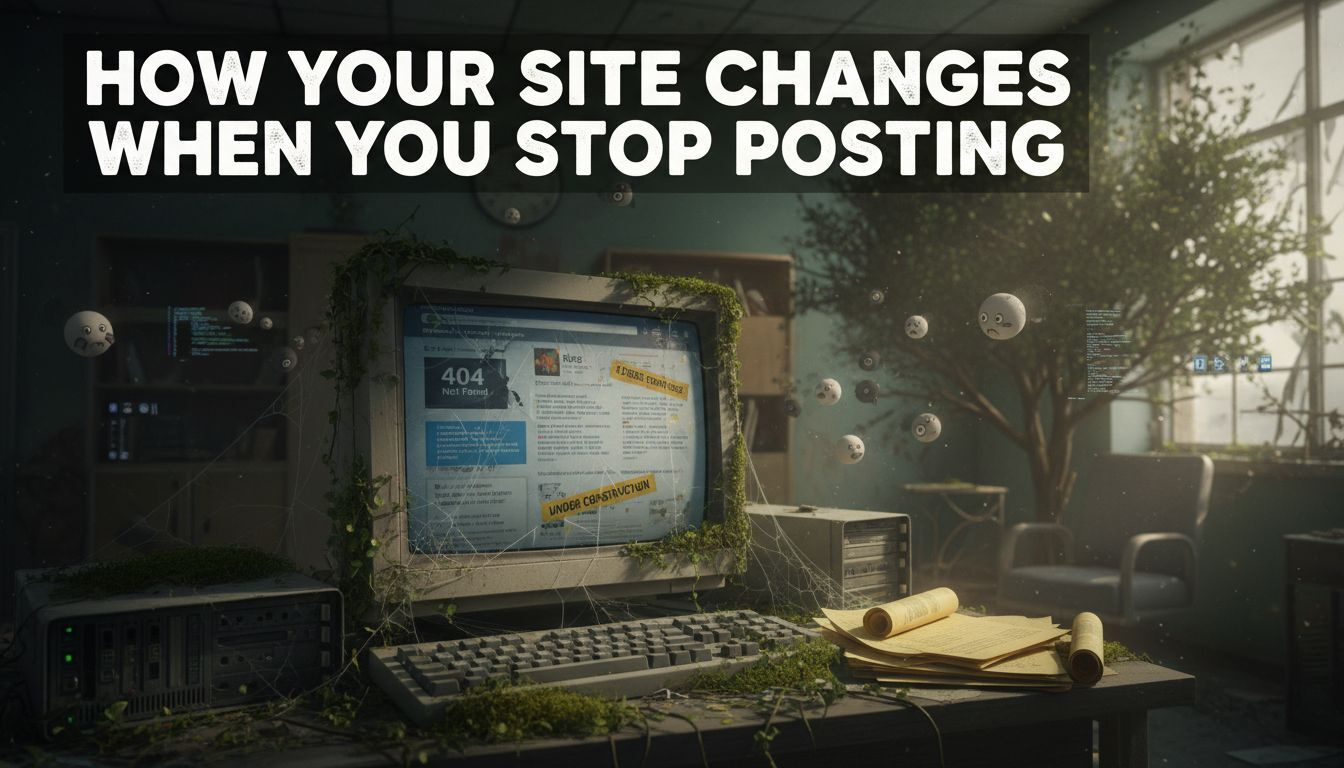
How Your Site Changes When You Stop Posting
What Happens to Your Site When You Stop Posting
You think a pause is harmless. It isn’t. A long pause—weeks, months, or years—creates a ripple effect that hits traffic, credibility, and bottom-line results. If you rely on your site for lead generation, brand authority, or consistent revenue, stopping posting is a decision with measurable consequences. This article breaks down what changes, why they occur, and how to minimize harm or recover quickly. You’ll find practical steps, real-world examples, and concrete actions you can take today to stabilize outcomes, even if you’re temporarily unable to produce new content.
Introduction and immediate risks are obvious: a drop in fresh content signals to search engines and users that your site is dormant. Over time, rankings decay, crawl frequency drops, and social signals weaken. The good news is you can tilt the odds back in your favor by controlling another pivotal factor: evergreen assets, internal linking, and consistent optimization of existing material. If you plan to pause, you can design a strategy that preserves traffic, sustains momentum, and positions you for a strong comeback when posting resumes. The key is to map the interruption, protect core assets, and maintain the perception of value for both readers and search engines.
What Changes When Posting Stops
1) Traffic declines and stabilizes at a lower baseline
New posts act as fresh air for the site, inviting search engines to re-crawl, re-index, and re-assess relevance. When posting stops, you lose the cadence that signals ongoing value. Traffic tends to fall as pages lose freshness and topical recency. The decline isn’t abrupt at first, but it compounds as internal links to new content vanish and external readers have fewer reasons to revisit. In many cases, benchmarked sites show a 20–40% drop within 6–12 weeks of no new content, followed by a slower decay if evergreen assets remain strong. The exact numbers depend on niche, competition, and how well your existing content covers core keywords. If you maintain high-quality evergreen pages and update a few older posts, you can blunt the descent and keep a respectable traffic floor.
2) News and trends become less covered, reducing topical authority
Seasons, product launches, and shifts in user intent move quickly. Your site’s authority grows when you respond to those changes with timely posts. A pause means you miss opportunities to capture trending queries, long-tail variations, and user questions. Over time, your site appears less current. Even if your content remains technically strong, the perception of relevance deteriorates if competitors publish timely material while you wait to resume.
3) Internal and external signals weaken
Internal signals—dwell time, click-through rates from index pages, and path depth—are influenced by content availability. If users land on a product page that links to outdated or irrelevant posts, engagement suffers. External signals, such as backlinks and social shares, fade if there’s no fresh material to reference. Over months, you may see fewer new backlinks and lower social amplification, making recovery slower when you restart.
4) Email and audience engagement degrade without ongoing touchpoints
Newsletters, push notifications, and social feeds rely on fresh content to drive engagement. A hiatus reduces opt-ins, click-through rates, and perceived value of your list. If you maintain a cadence of occasional updates, you can keep the audience engaged and preserve the habit of visiting your site, even if the volume of new content is reduced.
5) Monetization pressure and advertising yield shift
Monetization often tracks traffic and engagement. A sustained drop in visits typically lowers ad impressions or affiliate conversions. If you depend on ad networks, you’ll notice reduced RPMs. If you rely on affiliate links, reduced click-throughs translate into fewer commissions. You can counteract this by optimizing existing monetized pages, updating conversion paths, and running targeted evergreen promotions during a pause.
Strategies to Mitigate a Pause
1) Preserve value with evergreen content and optimization
Identify top-performing evergreen posts and keep them fresh with minor updates: add updated statistics, refresh visuals, check internal links, and ensure on-page SEO remains solid. Create a maintenance routine that touches high-traffic pages every 60–90 days. The goal is to maintain relevance and user satisfaction without requiring full new articles each week.
2) Leverage existing assets with repurposing
Turn long-form posts into smaller, linkable assets: summaries, checklists, how-to guides, or FAQs. Repurposing preserves visibility and allows your audience to consume content in different formats. This approach also supports SEO by expanding internal linking and keyword coverage without creating new core posts.
3) Strengthen internal linking and site structure
A solid internal linking framework helps preserve traffic when posting slows. Ensure every page has relevant internal connections, and create topic clusters that organize content around core themes. Rich internal networks help search engines discover and prioritize your evergreen pages, reducing the risk from pauses.
4) Optimize for user intent and existing queries
Audit top landing pages for alignment with user intent. Update meta titles, descriptions, and structured data to reflect current best practices. If you cannot publish new content, you can still improve rankings by optimizing on-page elements and ensuring fast load times and mobile friendliness.
5) Maintain an occasional publishing cadence
Even during a pause, publish lightweight content occasionally—like monthly micro-posts or updates. This keeps signals active and signals that the site remains alive. The forecast shows that a predictable, modest cadence is better than a long blackout for SEO health and audience trust.
Case Studies: Real-Life Outcomes
Case Study A: Niche blog recovers with asset optimization
A mid-size blog in a competitive niche paused posting for three months due to resource constraints. The team identified 12 evergreen articles with high search volume and updated each with new data and fresh visuals. They added five internal links per page and trimmed outdated references. Traffic dropped 18% in the first month but stabilized within five weeks, and by month two, revenue from display ads recovered to 92% of pre-pause levels. The key was preserving core value while avoiding a content drought. This approach minimized revenue loss while buying time to reallocate resources efficiently.
Case Study B: E-commerce site maintains performance through repurposing
An online retailer used a pause window to repurpose long guides into product-focused checklists and buying guides. They published 8 micro-guides and embedded them in product pages via callouts and banners. This maintained engagement and boosted on-page SEO signals. By the end of the pause period, organic traffic had declined only 9%, and average session duration improved due to targeted content experiences. The takeaway: repurposing content can preserve engagement and tighten the buyer journey without requiring new blog posts.
Case Study C: WordPress site leverages automation and SEO tuning
A WordPress site with a sizable archive implemented an optimization sprint: updated title tags, improved schema markup, and automated internal linking to top performers. They also deployed a lightweight content generator to produce occasional, factual summaries of older posts, ensuring freshness without full-scale production. Within two quarters, rankings for core keywords stabilized, and site traffic returned to near pre-pause levels. The incident shows that strategic SEO tuning plus controlled automation can bridge gaps when posting slows.
Actionable Playbook: 14-Point Plan for When You Pause
- Catalog all core pages by traffic and conversions. Prioritize assets with the highest impact.
- Audit for freshness: identify posts that are outdated or no longer aligned with current user intent.
- Update metadata on high-impact pages: titles, meta descriptions, and structured data where relevant.
- Strengthen internal links around pillar content to maintain topic authority.
- Refresh visuals and data points in evergreen posts to extend relevance.
- Repurpose top content into formats like checklists, FAQs, or quick-start guides.
- Create lightweight micro-posts (monthly) to signal ongoing activity without heavy investment.
- Implement a maintenance schedule: 60–90 day touchpoints for critical assets.
- Optimize site speed, mobile performance, and core web vitals to support existing content.
- Review monetization paths on high-traffic pages and tighten CTAs and conversion funnels.
- Set up automated alerts for ranking shifts or traffic changes to respond quickly.
- Ensure accessibility and readability improvements to maintain a broad audience reach.
- Document the pause plan and criteria for restarting publication to align teams.
- Prepare a restart ramp: a staged approach to reintroduce regular posting with a clear editorial calendar.
To illustrate, imagine a marketing site that normally posts three times weekly. During a pause, they shift to two priorities: refresh ten evergreen articles and publish two micro-posts per month. They also implement internal linking upgrades and a quarterly audit. The numbers tell the story: traffic losses were smaller than expected, and when publishing resumed, the editorial team hit a faster recovery due to the already optimized core assets. This is not about stalling; it’s about preserving value while planning a strategic comeback.
Practical Tools and Tactics for WordPress and Beyond
WordPress users can leverage a combination of SEO plugins, content calendars, and automation to weather a pause. Plugins can help with on-page optimization, XML sitemaps, and schema markup. A content generator can support the quick creation of factual summaries or meta content to fill gaps without compromising quality. The goal is to maintain continuity in user experience and search signals while you allocate resources elsewhere. Keep in mind that automation should never replace human quality on core posts; use it for auxiliary assets and updates that reinforce your pillars.
Strategic keyword handling matters. Maintain a focused keyword map for evergreen terms and seasonally relevant phrases. During a pause, you can deepen coverage around secondary keywords that support the main topics. The cumulative effect is a broader semantic footprint that sustains rankings even when new articles are scarce. You should track core metrics: organic traffic, impressions, click-through rate, average position, and conversions. A simple dashboard helps you monitor retention, not just volume, and prioritize actions that preserve ROI.
As you manage a pause, consider audience psychology. Your readers expect consistent value, even if not daily. Clear communication about your interim schedule helps set expectations and protect trust. If you announce a temporary pause with a transparent plan, you reduce anxiety among users who rely on your content. The alternative—silence without explanation—creates uncertainty and increases churn risk when posting resumes. The balance is honesty with a practical plan for sustaining value.
In-Depth Example: A Content Creation Agency’s Pause Strategy
A content agency faced a months-long pause due to staffing constraints. They cataloged 30 evergreen assets and updated each with new data and visuals. They repurposed five to produce client-facing templates and checklists, which became lead magnets. They published a quarterly roundup post linking to their optimized assets. The result: a smaller drop in organic traffic than anticipated and a smoother restart when hiring resumed. This approach shows the value of treating the pause as an active optimization window rather than a passive setback.
“Content is not a one-off act; it is a disciplined practice that builds trust over time.” — Content Strategist, 2023
Guiding Principles for Sustained Growth During a Pause
- Maintain clarity: define the pause duration, the assets to update, and the cadence for micro-posts.
- Preserve reader value: focus on accuracy, usefulness, and readability in every update.
- Protect SEO fundamentals: keep crawlability, mobile usability, and fast loading as a baseline.
- Be purposeful about automation: use generation tools to support, not replace, high-quality content.
- Prepare for a strong return: schedule a reactivation plan with an editorial calendar and resource alignment.
Along the way, you’ll encounter trade-offs. A longer pause saves immediate resources but increases the risk of traffic erosion. A shorter pause with a heavy repurposing program preserves engagement but consumes more time. The optimal path depends on your goals, available tools, and audience expectations. The core practice is measurable restraint: do only what preserves or enhances value while maintaining a clear path to restart with momentum.
In this context, AI and generation tools are double-edged swords. They can fill gaps, maintain signal, and accelerate repurposing, but they must be managed carefully to avoid content quality declines or keyword stuffing. The goal is a balanced mix: use AI to draft outlines, summaries, or templates while editors ensure accuracy, tone, and usefulness. For WordPress sites, this means choosing reliable plugins, setting guardrails for automation, and keeping human oversight central to every published piece. The result is a resilient site that remains visible, credible, and capable of a rapid rebound when posting resumes.
In summary, stopping posting does not doom a site if you act deliberately. Preserve value through evergreen assets, repurpose where possible, strengthen internal linking, and keep a lightweight publishing cadence to signal ongoing activity. Monitor the right metrics and maintain a clear plan for restarting. The pattern is simple but effective: protect core assets, extend their life, and prepare a thoughtful comeback. If you can pull this off, your site won’t just weather a pause; it will emerge stronger and more focused on what readers actually need.
According to a reputable AI content optimization resource, sustainable visibility is built on disciplined maintenance and intelligent reuse of existing material. This perspective aligns with practical outcomes: fewer hours spent creating new content can still deliver strong traffic stability when you optimize what you already have and maintain trust with your audience. It’s not magic; it’s a disciplined approach that treats pauses as strategic windows rather than blackouts.