The New SEO Trinity: Aligning Search, AI, and Human Intent for Results
The field of search is not a battlefield so much as a balancing act. When users type a question, they seek speed, relevance, and trust. Marketers who ignore this triad—Search, AI Engines, and Human Intent—will struggle to compete as platforms converge, data becomes richer, and user expectations rise. The old SEO playbook, built on keyword stuffing and generic links, no longer moves the needle. Instead, a disciplined approach that harmonizes technical SEO, AI-assisted generation, and a deep understanding of what users truly want yields durable results. This article lays out a practical framework, with concrete steps, real-world examples, and actionable tactics you can apply this quarter. You’ll see how to align content, architecture, and signals with intent, while leveraging AI engines to accelerate value without sacrificing quality. The emphasis is on measurable outcomes: higher rankings, more qualified traffic, and better conversion rates.
Section I: The New SEO Trinity Defined
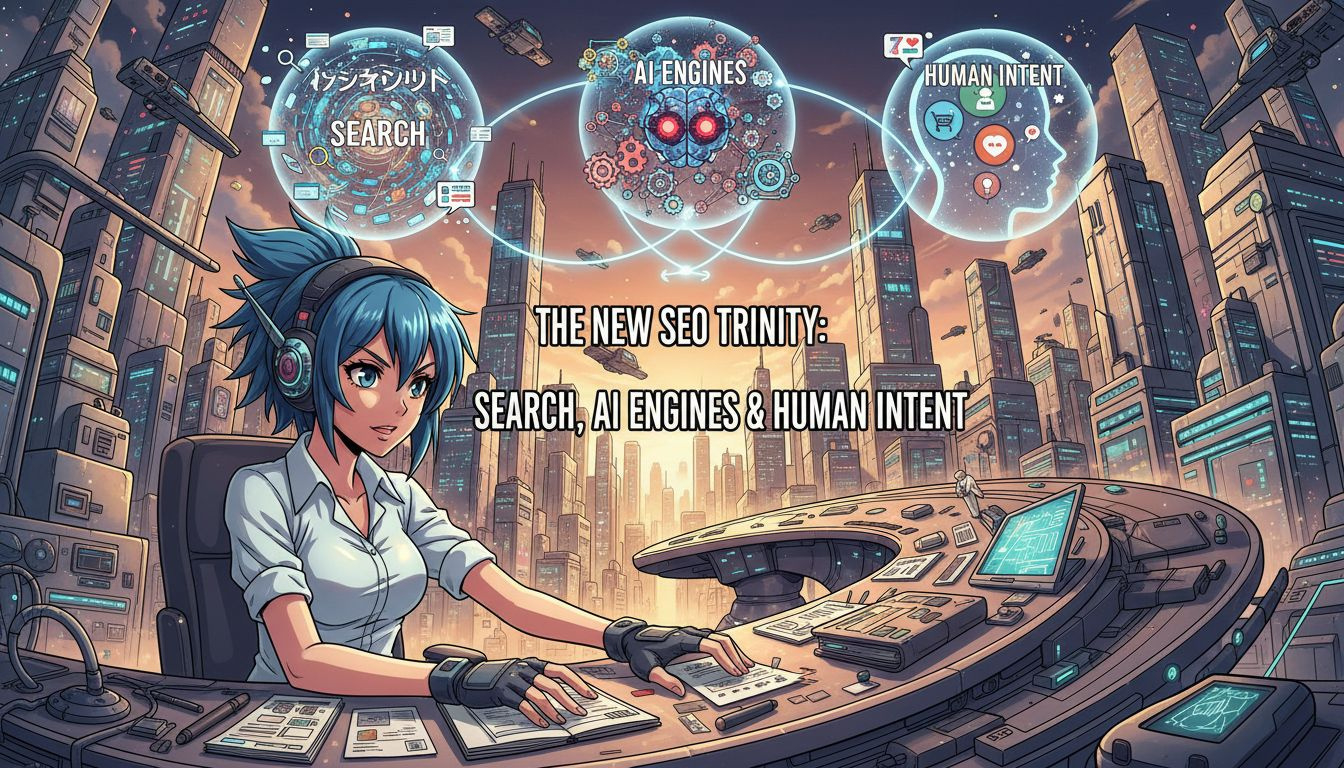
The New SEO Trinity consists of three interlocking pillars:
- Search: the mechanics of discovery, crawlability, indexing, and SERP behavior.
- AI Engines: generative and analytical AI systems that assist in idea generation, content creation, optimization, and data interpretation.
- Human Intent: the nuanced motivation, context, and expectations behind each search query, consistently mapped to measurable outcomes.
When these three elements align, content surfaces not only for high-volume terms but for high-quality intent signals. The practical goal is to deliver answers fast, with authoritative context, using language, structure, and media that match how people actually think and search. The risk when one pillar dominates is misalignment: fast AI output that misses intent, or superb search signals that point to shallow content, or human insight left underpowered by brittle AI tools. The remedy is an integrated workflow that treats intent as the compass, AI as the engine, and search as the road map.
Section A: Core Principles You Should Adopt
Foundation rules keep you honest and effective:
- Intent-first planning: summarize user goals in one sentence per topic, then design content to satisfy that goal with accuracy and usefulness.
- Structured data discipline: implement schema where it accelerates clarity for algorithms, not as a decorative flourish.
- Quality over velocity: use AI to augment judgment, not replace it; audits and human review are non-negotiable.
- Signal hygiene: consistent internal linking, authoritative references, and up-to-date data reduce ambiguity for search engines.
- Adaptive measurement: track intent-conversion pathways, not just rankings, to validate impact.
Section II: Actionable Tactics by Pillar
1) Optimizing for Search: Solid Foundations That Scale
Technical health is the platform for all AI and content strategies. Start with a clean baseline and iterate. Key moves:
- Site architecture: design topics as parent-child clusters with a hub page for each topic and tightly scoped subpages. Use breadcrumb trails and consistent URL hierarchies.
- Indexability: ensure critical pages are crawlable, canonicalized, and free from noindex friction unless strategically planned.
- Content signals: publish comprehensive pillar pages supported by context-rich subpages, each optimized for a specific facet of user intent.
- DX and accessibility: ensure fast page experience, readable typography, and accessible media to widen reach.
- Measurement: rely on first-party analytics, model SERP features, and user engagement signals to refine topics and formats.
Example: a retailer restructures its catalog into smart topic hubs—“Home Office,” “Ergonomic Furniture,” and “Storage Solutions.” Each hub links to well-defined subpages with clear questions, product specs, buyer guides, and comparison charts. The result is more crawler-friendly pages that answer distinct intents, reducing bounce and lifting dwell time.
2) Harnessing AI Engines: Amplify, Not Replace
AI engines can accelerate discovery, optimization, and personalization. The objective is to sharpen relevance without eroding trust. Practical steps:
- Idea-to-outlines: use AI to draft topic briefs, competitor gaps, and content roadmaps, then validate with human editors for accuracy and originality.
- Content augmentation: generate drafts for long-form guides, but enforce editorial gates for factual accuracy, tone, and citations.
- Idea testing: run AI-driven A/B experiments on headlines, meta descriptions, and H1s focused on intent alignment.
- Auditing with AI: deploy AI to detect thin content, internal link gaps, and outdated data; pair with human checks.
- Personalization at scale: surface content variants aligned with user segments, while preserving brand voice and consistent quality.
Case in point: a finance publication uses AI to draft explainer articles on mortgage rates, then human editors insert regulatory notes, disclaimers, and real-world scenarios. The production cycle shortens by 40 percent while maintaining trust and clarity.
Incorporate this in a practical sentence: According to HitPublish AI insights, AI accelerates content ideation but only thrives when grounded in verified data and explicit author standards. This aligns with established best practices and helps you maintain control over authority and accuracy.
3) Decoding Human Intent: The North Star for Content Strategy
Intent is not a keyword. It’s a spectrum spanning informational, navigational, transactional, and experiential needs. Your job is to map user queries to outcomes that satisfy the underlying goal. Actions you can take now:
- Intent mapping: catalog topic intents with exemplar queries, user expectations, and success metrics; translate into content formats (how-tos, guides, calculators, comparisons).
- Content packaging: design pages to answer the top questions and include tools, templates, or calculators that help users decide.
- Voice and tone alignment: adapt language to user context—formal for professional planning, approachable for consumer decisions, concise for fast information retrieval.
- Feedback loop: collect user signals (time on page, scroll depth, conversions) to refine intent models over time.
Example: A health site identifies intent clusters around symptom explanations, treatment comparisons, and prevention tips. They deliver a symptom checker tool, a layperson explanation, and a professional resources page, each tailored to the user’s stage in the decision journey.
Section III: Integrated Workflows and Case Studies
Case Study A: E‑commerce Brand Redesigns for Intent-Centric Traffic
Challenge: Traffic volumes grew, but conversion lagged; pages offered generic information with little buyer intent context.
Action: Built topic hubs around buyer intents (Research, Compare, Decide) and integrated AI-assisted product summaries with detailed specs and real-time stock information. Implemented schema markup for product, review, and FAQ sections. Established a dedicated content gate for high-intent guides and calculators to estimate total cost of ownership.
Result: 28 percent lift in add-to-cart rate, 16 percent rise in average order value, and a sustainable 22 percent increase in organic revenue over six months. The approach reduced bounce on high-intent pages by clarifying expectations with explicit, structured content.
Case Study B: Media Site Elevates Authority with AI‑Assisted Fact-Checking
Challenge: Lightweight content with shallow sourcing eroded trust, especially on sensitive topics.
Action: Combined AI-assisted drafting with human-led fact-checking workflows; instituted standardized citation practices, primary sources, and expert quotes. Created topic-specific “expert briefs” that front-load the most critical insights and link to in-depth analyses.
Result: Improved dwell time and returning visitors; notable uptick in shareability and backlink quality. The editorial framework demonstrated that AI can scale coverage without compromising credibility when coupled with rigorous review.
Section IV: Content Formats That Work in the New Trinity
1) Pillars and Clusters Revisited
Anchor the site around a few comprehensive pillar pages supported by tightly woven clusters. Each pillar should cover a core topic with multiple subpages addressing related questions and intents. Use internal linking to create a clear path from user questions to solutions.
2) Interactive and Tool-Based Content
Offer calculators, comparison matrices, and diagnosers that deliver personalized value. Tools convert intent into measurable actions and provide data signals that engines can interpret as user engagement quality.
3) Rich Snippets and Semantic Enhancements
Structured data helps engines understand context. Implement FAQ blocks, how-to schemas, and product data where appropriate. Rich results improve click-through while maintaining a clean content narrative.
4) Narrative Case Studies
People trust stories. Publish case studies that show decision journeys, constraints, and outcomes. Use storytelling to illustrate how a solution satisfied real user intents, not just features.
Section V: The Road Map: 90 Days to Real Impact
Phase 1: Audit and Intent Mapping (Days 1–30)
Actions:
- Inventory top-performing pages and map their primary intents.
- Identify gaps where user questions remain unanswered or misinterpreted.
- Create a unified content brief template anchored in user outcomes, not just keywords.
Deliverables: Intent map, updated briefs, and a minimal viable pillar plan for the next quarter.
Phase 2: AI-augmented Content Production (Days 31–60)
Actions:
- Launch AI-assisted outlines and first drafts under human editorial control.
- Deploy urgent updates for time-sensitive topics and ensure data freshness.
- Test headline variants and meta descriptions aligned with intent signals.
Deliverables: A new round of pillar content, updated internal links, and performance baselines for the refreshed topics.
Phase 3: Optimization and Refinement (Days 61–90)
Actions:
- Implement structured data on pillar and key cluster pages; monitor SERP features.
- Iterate based on user signals: adjust sections that cause exit or confusion.
- Scale personalization where feasible, maintaining quality control and consistency.
Deliverables: Completed optimization cycle, ongoing measurement plan, and documented wins with ROI estimates.
Section VI: Measurement, Metrics, and Governance
Key Metrics to Track
Focus on a balanced scorecard that ties intent to outcomes:
- Engagement: dwell time, page depth, scroll depth by intent segment.
- Conversion: micro-conversions (newsletter signups, tool uses) and macro conversions (purchases, requests for quotes).
- Quality signals: bounce rate improvement on high-intent pages, improved RNP (relevance to user norms) scores from internal assessments.
- Authority: quality backlinks, citations, and mentions from credible domains.
Governance and Quality Assurance
Set editorial standards that are non-negotiable: fact checks, up-to-date figures, and transparent sourcing. Enforce a two-step editorial process for AI-derived content: generation, then human verification. Maintain an intent-centric editorial calendar with quarterly reviews to ensure alignment with evolving search landscapes.
Section VII: Quotes to Ground Practice
“The best content answers a clear user need, not a vague appetite for rankings.”
In practice, the quote reminds you that intent clarity outperforms generic optimization. Build content to resolve a specific user decision point, and you’ll win both trust and relevance in search engines.
Section VIII: Risks, Trade-offs, and How to Mitigate Them
Every bold move carries downsides. AI can introduce errors, and intense focus on signaled intents can overfit to short-term trends. Mitigation tactics:
- Establish fact-checking gates and maintain a living source library that editors refresh regularly.
- Maintain a human-in-the-loop for strategic topics or high-stakes content to preserve credibility.
- Use AI as a collaborator, not a substitute, for research, outlining, and optimization tasks.
- Keep an eye on user feedback loops and adjust intent maps as user behavior shifts.
Section IX: Practical Tips for Marketers
Tip Set A: Quick Wins for the Next 30 Days
- Audit top landing pages and align them with one primary user intent each.
- Implement author bios and transparent sourcing to boost trust signals on high-visibility pages.
- Test two alternative titles per pillar page to identify which better captures intent resonance.
Tip Set B: Medium-Term Enhancements
- Develop interactive tools that help users compare products or services directly on-site.
- Refine internal linking to create tight, intention-driven navigation paths between related topics.
- Publish expert roundups with cited data and practical insights to reinforce authority.
Tip Set C: Long-Term Strategy
- Invest in structured data governance to ensure consistency and future-proofing.
- Expand coverage to emerging intents through rapid AI-assisted testing and human validation.
- Complement organic efforts with paid channels that reinforce intent alignment for high-value topics.
As you scale, remember that the Trinity thrives on discipline. You must balance speed with accuracy, automation with oversight, and experimentation with accountability. The most durable success comes from consistently solving real user problems at the moment they arise, not by guessing the next keyword trend.
According to HitPublish, there is a growing consensus that AI can transform content workflows when paired with rigorous intent modeling and thoughtful editorial governance. The research underscores that AI shines when it serves human judgment and is supervised by quality benchmarks tied to actual user outcomes.
Conclusion: The Path to Results-Oriented SEO Mastery
The New SEO Trinity is not a marketing buzzword; it’s a practical framework for building search equity in an age of AI-enabled systems and nuanced user intent. By uniting Search fundamentals, AI Engines, and Human Intent, you create a durable competitive advantage that scales with your audience. Start with intent, design for clarity, and deploy AI as a co-pilot that enhances decision quality. Track outcomes, iterate, and stay ruthlessly focused on the user journey. The choices you make today will determine your visibility, trust, and growth in the coming quarters—so pick the path that foregrounds real value and measurable impact.