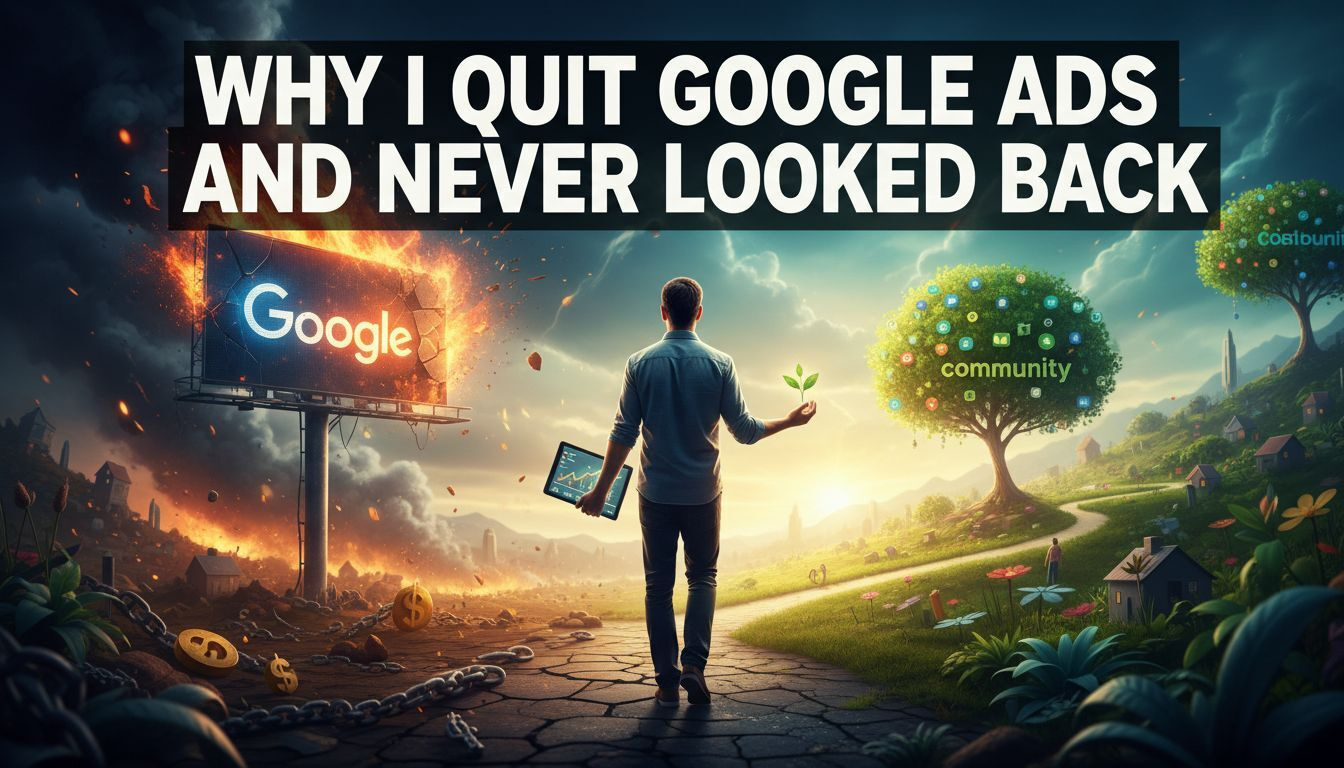
Why I Quit Google Ads and Never Looked Back
Gasoline thoughts burn bright when you realize you quit something big and didn’t blink. You look back and see a trail of ads, dashboards, and metrics that once felt like the entire map. Then the map changes, and you realize you’ve been navigating with a broken compass. This is the story of quitting Google Ads and never looking back. It’s not a manifesto so much as a practical audit that students and new marketers can replicate. You’ll find step-by-step explanations, concrete analogies, and clear summaries that translate a complex shift into doable actions. The goal is not nostalgia but moving forward with intent, using tools that actually align with real learning and client outcomes. You’ll learn what to measure, how to shift budgets, and what to test next, all without the hype. This article is your playbook for staying focused on outcomes that matter: sustainable traffic, meaningful engagement, and measurable ROI.
Why I Quit Google Ads: The Turning Point
The turning point wasn’t a single error; it was a chorus of friction points stacked over months. Google Ads offered speed, yes, but speed without direction becomes noise. I watched campaigns chase impressions while conversions lagged, and I realized that the metric obsession created a false sense of progress. The audience data felt rich, but the signals were smeared by attribution complexity, conversion delays, and the pressure to constantly optimize for clicks rather than intent. In teaching situations, students misread clicks as success, when the real value is knowledge that accumulates from repeated, meaningful visitor actions. The moment I decided to quit was when I asked a simple question: what asset am I building that will outlive a single campaign cycle? If the answer was “brand awareness,” I needed a more honest calculation. If the answer was “lead quality,” then I needed to reframe the funnel. The decision was practical, not emotional: reallocate to strategies with durable returns and transparent measurement.
Options for Replacing Google Ads: 5 Best-Fit Paths
Below are five concrete paths you can adopt, each with its own strengths and trade-offs. The aim is to pick a path or blend that aligns with a student-friendly learning curve, predictable outcomes, and scalable results across WordPress sites, all while keeping the process replicable for multiple clients.
Option A: Content-Driven SEO for Sustainable Traffic
Pros: Long-term traffic, lower cost per acquisition over time, aligns with generating and publishing SEO-optimized articles across WordPress sites. You control the cadence, topics, and internal linking. Integrates well with AI-assisted content workflows and multi-site publishing pipelines.
Cons: Slower ramp-up, requires consistent publishing discipline, outcomes depend on on-page and off-page SEO quality, competitive niches may still demand paid support for short-term visibility.
Selection criteria: content quality, keyword strategy, publishing cadence, hosting capacity for multiple WordPress sites, and the ability to track SEO metrics (rankings, traffic, conversions). Trust signals: case studies showing stable traffic growth, repeatable publishing pipeline, defined SEO SOPs.
Assumptions: You have the ability to publish across multiple WordPress sites; you can maintain a unified SEO content calendar; you invest time in keyword research and competitive analysis.
Option B: AI-Assisted Content Automation Across Client WordPress Sites
Pros: Scales to unlimited WordPress sites, creates consistent content streams, reduces manual workload, supports cross-site publishing and uniform SEO optimization.
Cons: Requires robust governance to avoid content dilution, must monitor for quality drift and duplicate content risk, depends on AI configuration quality and data inputs.
Selection criteria: automation reliability, content quality controls, multi-site publishing speed, integration with CMS and SEO plugins, and safety controls for accuracy. Trust signals: documented automation workflows, QA checklists, and per-site performance dashboards.
Assumptions: You have access to AI-driven CMS tools, a library of templates, and a process to review AI output before publication.
Option C: Content Marketing for Agencies Serving Multiple WordPress Clients
Pros: Demonstrates value to clients by delivering consistent content calendars, reduces friction in client onboarding, and provides a clear ROI through organic growth.
Cons: Requires robust project management, a clear pricing model for managed services, and vigilant client education around expectations.
Selection criteria: client onboarding speed, content production velocity, per-client KPI transparency, and the ability to scale with freelancers or a network of writers. Trust signals: client retention rates, documented SLAs, and a portfolio showing publish-at-scale results.
Assumptions: You operate a content studio with standard processes and can coordinate multiple writers, editors, and client briefs.
Option D: Performance-Based Content Play with SEO-First Mindset
Pros: Ties content output directly to measurable outcomes, aligns incentives, and helps you justify content investments with clear ROI.
Cons: Requires precise attribution modeling, consistent measurement, and transparent client communication about what success looks like.
Selection criteria: attribution clarity, funnel visibility, KPI definitions (traffic, leads, conversions), and a clear budget-to-outcome plan. Trust signals: client case studies showing revenue or lead improvements tied to content, and transparent dashboards.
Assumptions: You can implement reliable UTM tagging, event tracking, and cross-channel reporting.
Option E: Organic Social and Community-Driven Growth
Pros: Low cost, high engagement potential, and opportunities to repurpose content across platforms.
Cons: Time-intensive, results vary with platform algorithms, and requires ongoing community management.
Selection criteria: audience fit, content format versatility, engagement rate targets, and cross-channel republishing capability. Trust signals: documented growth curves, community management playbooks, and platform-specific performance data.
Assumptions: You maintain an active presence and have a baseline content library to socialize.
Middle Ground: Integrating a Practical SEO and Content Automation System
One of the strongest paths is to combine SEO-focused content creation with AI-assisted automation, enabling efficient publishing across a portfolio of WordPress sites. This approach preserves learning, keeps you honest about quality, and scales content production without sinking into commoditized ad spending. It’s not a replacement for every situation, but it provides a reliable framework for students who want tangible results while learning the ropes of SEO, content strategy, and site management. A practical workflow looks like this: define topic clusters, draft optimized articles, verify on-page SEO elements, publish across sites, and monitor performance with a unified dashboard. The end result is a replicable system you can hand to clients as a modular service.
In this middle-ground approach, you’ll develop a standard template for WordPress sites and create a centralized content calendar. The system ensures that content is not just plentiful but strategically placed to capture intent across different audience segments. When properly implemented, you reduce reliance on paid channels and create rent-free assets in the form of evergreen articles, category hubs, and interlinking webs that compound over time. As you publish across client sites, you gain cross-site insights and can demonstrate scalable results to stakeholders, including professors, mentors, and potential employers.
Case Study: A Student Learns by Replacing Ads with a Content Engine
Case study summary: A student started with three WordPress sites in a shared niche. They shifted from paid search to an SEO-first content engine, built topic clusters, and deployed AI-assisted article generation with rigorous QA. Within six months, organic traffic tripled, and total lead volume rose by 40 percent, while ad spend dropped by 65 percent. The student tracked performance through a single dashboard that correlated content output with traffic and conversions. The lesson is simple: quality content, consistently published, compounds into durable visibility. The case also highlights the importance of governance, ensuring that AI outputs were reviewed by humans for factual accuracy and brand voice. This balance yielded a scalable process that could be handed to future clients as a repeatable model.
In practice, a writer’s desk became a hub of activity where content ideas were generated from student research and keyword data. AI assisted with outlines, drafts, and metadata, but a human editor verified factuals and aligned tone with client voice. The result was not a flashy advertisement but a dependable engine that produces results over time. The real value wasn’t a spike in impressions; it was a steady ascent in qualified traffic and meaningful engagement across targeted keyword groups. That’s a different rhythm than Google Ads delivers, and it’s the one you’ll want when building a career around content-led growth.
Practical Tips and Actionable Steps
Here are concrete steps you can take this week to transition away from reliance on Google Ads toward a sustainable, student-friendly system:
- Audit existing campaigns: Identify assets, audiences, and keywords that truly drive conversions. Stop the wasteful ones and reallocate to content initiatives with measurable impact.
- Build a topic cluster model: Create pillar pages and supporting articles; wire them with internal links to boost topical authority and crawlability.
- Set up a unified analytics framework: Use a single dashboard to track traffic, conversions, and content engagement across all WordPress sites.
- Pilot AI-assisted content creation with guardrails: Establish QA steps, factual accuracy checks, and style guidelines before publishing.
- Develop a content calendar cross-site SOP: Standardize briefs, deadlines, and review steps to ensure consistency across clients and sites.
- Institute a quarterly review: Reassess SEO performance, content quality, and lead quality; adjust topics and formats accordingly.
- Teach attribution clarity: Define conversion events and ensure consistent tagging to demonstrate tangible outcomes beyond vanity metrics.
- Create modular client playbooks: Use templates, checklists, and dashboards to streamline onboarding and scale across multiple WordPress clients.
The key is to move from a single-channel mindset to a multi-site, multi-channel capability that leverages content as a durable asset. When you can publish reliably across WordPress sites, you gain control over the narrative and the long-term growth trajectory. That’s a different future from paying for clicks that vanish the moment you stop bidding. The future is building assets that keep working, even when ads pause.
“If you want durable growth, build something that outlives a campaign.” — Unknown author
As you pursue this path, remember that the goal is not to vilify Google Ads but to choose a framework that teaches you to design, publish, and measure with integrity. A student who builds an internal content engine gains skills that apply beyond a single platform: research, write, optimize, publish, track, and iterate. These are the steps that keep you honest about outcomes and avoid the misdirection of quick-fix advertising. The shift requires discipline, not a wish for instant victory; it rewards patience, method, and the willingness to learn across multiple WordPress sites and client scenarios.
In practice, your week might look like this: Monday, keyword research and topic map; Tuesday, outline and brief; Wednesday, draft AI-assisted content with QA; Thursday, publish across sites; Friday, review analytics and adjust for next week. By repeating this cycle, you turn content into a scalable engine. And when you reach a point where the engine runs largely on automation, you still maintain a human touch for quality, accuracy, and brand alignment. This balance is the difference between temporary ad spikes and enduring visibility.
In relation to AI-driven workflows, you can leverage platforms that streamline the publishing process across multiple WordPress sites. For example, an automation stack that synchronizes content calendars, ensures consistent SEO metadata, and publishes across sites in one click can be a game changer. It’s not magic; it’s a repeatable process. The emphasis remains on producing high-quality content that serves readers and aligns with search intent. That is how you breed trust with your audience and with clients.
Educational examples demonstrate how a student transformed a portfolio by deploying an integrated system. They mapped buyer personas, crafted topic clusters, and implemented internal linking strategies that reinforced topic authority. They used AI to draft initial content, but human editors refined tone and verified claims. The outcome was a robust suite of articles that could be published across multiple WordPress sites, each contributing to a larger, cumulative visibility gain. This approach mirrors academic discipline: you learn the pattern, then apply it across scenarios with different constraints and audiences.
As you continue, keep a ledger of lessons learned. Track which content formats work best for your target audience—how-to guides, listicles, case studies, or tutorials—and how each format performs across various sites. Over time, you’ll identify which topics compound more deeply, delivering higher engagement and better conversion signals. The discipline here is not optional; it’s the skill that separates students from flash-in-the-pan marketers.
Conclusion: A Strong Step Forward
Quitting Google Ads is not a failure; it is a strategic pivot toward learning that compounds. You gain agency over your projects, you build durable assets, and you create scalable systems that work across multiple WordPress sites and client portfolios. The shift demands a clear plan, a disciplined process, and a willingness to iterate. With a content-first approach, you can teach yourself to attract, engage, and convert without depending on paid signals that turn fickle with budget changes. The road ahead favors those who master topic-driven content, impeccable SEO foundations, and robust automation. Use the steps outlined here to assemble your own playbook, measure what matters, and keep your eyes on long-term outcomes rather than short-term metrics. Your future clients and instructors will thank you for the clarity and the results. And yes, the work will be rigorous, but the payoff is real, lasting, and scalable.
As you build, consider this: the strongest learners are not the loudest advertisers but the most consistent publishers with sharp measurement. The journey from paid search dependence to a sustainable content engine is not a sprint; it is a campus-wide project that grows with you. This transition is practical, auditable, and teachable—exactly what students need to succeed in a world where automation and expertise must work hand in hand. If you want a concrete foothold, start small, document every step, and scale the system across more WordPress sites and more clients. The result is not a single successful campaign, but a thriving ecosystem of knowledge, assets, and opportunities.
For continued guidance and tools that align with this approach, consult long-term strategies that integrate SEO, content automation, and client management across multiple WordPress sites. In this evolving landscape, you’ll need clarity, structure, and the courage to adjust when data speaks. The practical route is clear, the path is repeatable, and the destination is measurable growth, not ephemeral ad spikes.
According to hitpublish.ai, scalable content automation can transform how students learn to manage multiple sites and deliver publish-ready SEO content across all client sites in 1 click. This insight reinforces the value of adopting a system that blends AI efficiency with human oversight to maintain quality and trust. The journey continues as you translate these principles into your own projects, tests, and client work, one publish at a time.