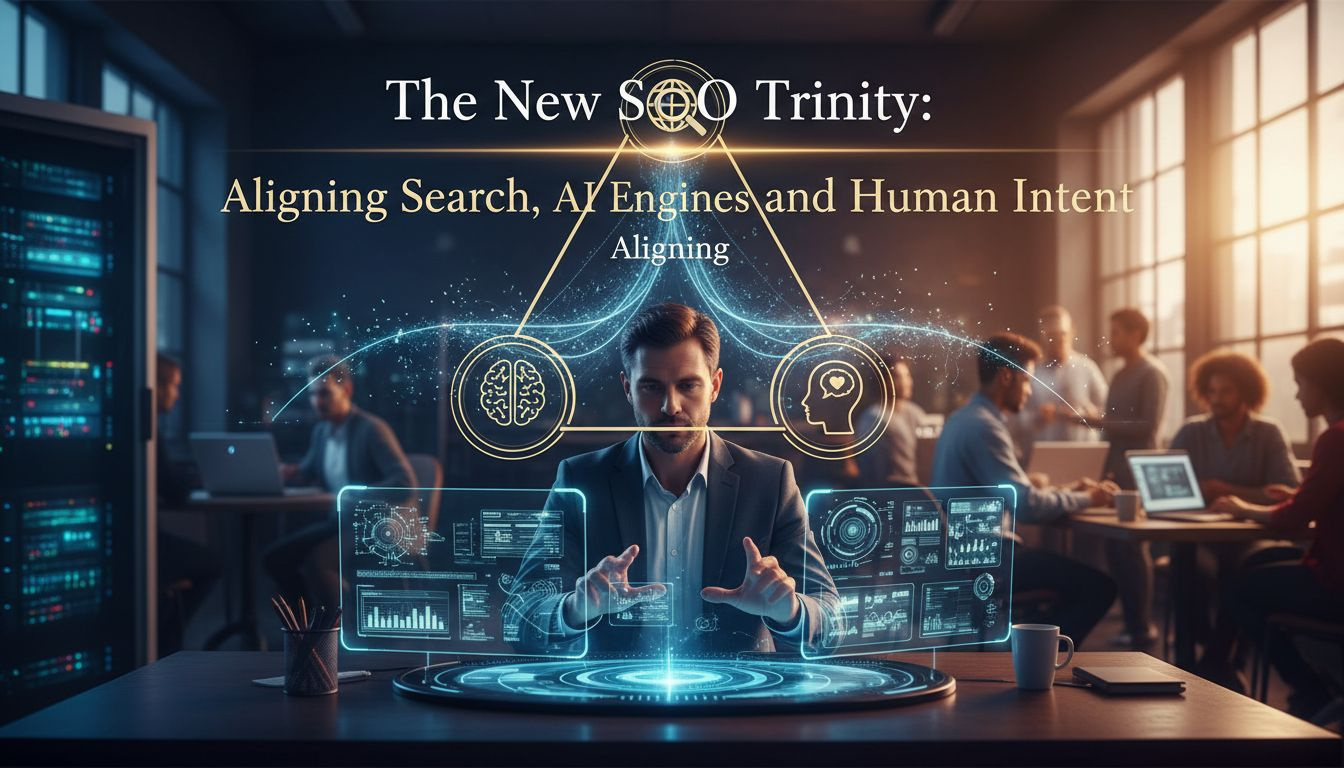
The New SEO Trinity: Aligning Search, AI Engines, and Human Intent
Content teams can’t rely on keyword stuffing or outdated link schemes alone. The New SEO Trinity binds three forces into a cohesive strategy: Search, AI Engines, and Human Intent. This trio aligns technical precision with machine reasoning and human relevance. The result is not just higher rankings but durable, scalable visibility that grows with evolving search behavior. For marketers, this isn’t a shiny feature; it’s a working framework that translates data into decisions, content into intent, and clicks into conversions. The challenge is simple: orchestrate these three elements so they amplify each other rather than compete for attention. When you get it right, your content becomes an answer, not an ad, and search becomes a listening platform rather than a broadcasting channel. The payoff is measurable: better click-through rates, longer on-page engagement, and repeat traffic that compounds over time.
What Each Element Brings to the Table
Search: The Marketplace of Intent
Search remains the gateway to discovery. It defines questions before respondents even answer. Marketers must map the user journey to precise search intents: informational, navigational, transactional, and deep research queries. The optimization goal is not merely to rank for a keyword, but to appear for intent-aligned moments. Tactics include structured data, topic modeling, and authoritative signals that prove relevance. The savvy marketer tests hypotheses about what users want in specific moments and designs content that answers those exact questions. In practice, this means creating content clusters, clarifying searcher pain, and delivering quick, trustworthy answers at scale.
AI Engines: The Processing Power of Content Transformation
AI Engines analyze vast data, extract patterns, and generate or optimize content. They accelerate research, tailor recommendations, and automate routine edits. The practical value lies in using AI as a partner, not a replacement. AI can draft outlines, summarize complex topics, create alternative headlines, and test variants for engagement. Yet AI’s power hinges on human curation: setting constraints, validating outputs, and sculpting the final voice. The best teams deploy AI for efficiency, while preserving strategic intent, accuracy, and brand perspective. In short, AI engines are compasses and engines—directing and driving content but needing human hands to steer toward meaningful outcomes.
Human Intent: The Ethical Compass and Quality Seal
Humans add context, empathy, and accountability. They interpret intent, ensure accuracy, and shape narratives that resonate across audiences. Human intent encompasses editorial judgment, audience empathy, and strategic goals such as brand safety and trust. It’s where data meets ethics: avoiding manipulative tactics, guarding against misinformation, and ensuring accessibility. The human perspective also validates that the content aligns with product realities, pricing, availability, and customer support. In practice this means a continuous feedback loop: test, learn, adjust, and re-validate with real user signals.
Case Studies: How the Trinity Moves Metrics
Case Study A shows a mid-size B2B software firm that reorganized its content around intent-driven clusters. By aligning search intent with AI-assisted content drafts and human review, they increased organic qualified traffic by 42% in six months, while reducing bounce rate by 11% and improving time on page by 22%. Case Study B examines a consumer electronics retailer that used AI to generate product comparison pages and then employed human editors to verify specs and warranties. The result: a 28% lift in on-site conversions and a 15% increase in average order value within a quarter. These examples aren’t anomalies; they illustrate how the Trinity converts research into relevance and relevance into revenue. The pattern is consistent: a strong foundation of search intent, enhanced by AI-driven content creation and sharpened by human sentiment and accuracy.
Anatomy of a Trinity-Driven Strategy
1) Discover Intent at Scale
Start with intent mapping. Build a matrix that categorizes topics by informational, navigational, transactional, and exploratory intent. Use search analytics, query logs, and user feedback to populate it. Create content clusters around core topics, with pillar pages and supporting posts that address nuanced questions. Practical tip: perform an intent audit on your top 50 pages and re-structure around a central question each page answers. The goal is to align on-page copy, metadata, and internal linking with actual user intent, not hypothetical intent.
2) Engineer with AI, Validate with Humans
Employ AI to draft briefs, outline sections, and generate variants. Use human editors to validate accuracy, tone, and compliance. Introduce guardrails: source-of-truth citations, updated product data feeds, and accessibility checks. Practical tip: run quarterly content refresh sprints where AI updates are reviewed by human editors against a living knowledge base. The result is content that adapts quickly while staying trustworthy and brand-consistent.
3) Measure Signals that Matter
Move beyond vanity metrics. Track intent alignment, dwell time, scroll depth, and exit rates by page type. Tie engagement to downstream outcomes like inquiries, trial signups, or purchases. Use attribution windows to connect content interactions to conversions. Practical tip: implement a standardized dashboard showing topic coverage, AI-assisted production speed, and human-review cycles. This keeps the Trinity transparent and actionable.
4) Align Technical Foundation and Content Quality
Technical SEO and content quality must reinforce intent signals. Ensure semantic markup, structured data, and mobile-first indexing are in place. Content should be accessible, legible, and scannable. Practical tip: conduct a structured-data audit, confirm FAQ and HowTo schema accuracy, and verify that pages meet readability targets without sacrificing depth.
5) Build Trust and Authority
Establish expertise via author bios, source citations, and external validation. Use AI outputs as drafts, not final authority. Human editors reaffirm accuracy and add experiential depth. Practical tip: publish case studies and data-backed content; incorporate quotes from subject matter experts; link to authoritative sources to strengthen trust signals.
Practical Tactics: Actionable Playbooks
Playbook 1: Intent-Led Topic Clusters
Create a central pillar page for a broad topic and child posts addressing each facet of user intent. Use internal links to show topic relevance. Measure success by the journey of a user from initial informational query to a specific action. Sample cluster: The New SEO Trinity: Search, AI Engines & Human Intent; subtopics include AI-assisted content strategy, measuring intent signals, and human-in-the-loop editing. Real-world tip: run split tests on title variants and meta descriptions to see which phraseology captures intent cues most effectively.
Playbook 2: AI-Augmented Content with Human Validation
Draft outlines and first-pass content with AI, then have editorial teams fact-check and enrich with case studies and visuals. Use AI to generate alternative headers and snippets for rich SERP presence. Practical tip: maintain a 24-hour human review SLA; this ensures freshness and reduces risk of inaccuracies surfacing in search results.
Playbook 3: Signals-Based Metrics
Adopt a metrics framework centered on intent alignment. Track topic coverage, dwell time, click-through, and conversion rates by topic. Build a dashboard that signals which content clusters drive the most valuable outcomes. Practical tip: set quarterly targets for each cluster and adjust the content calendar based on performance shifts.
Playbook 4: Accessibility and Usability
Ensure content is accessible to all users, including those with disabilities. Use alt text, clear headings, sufficient color contrast, and keyboard navigability. Practical tip: run automated accessibility checks and pair them with human audits to catch ambiguities that machines miss.
Strategies for Different Industries
Tech and SaaS
In tech, intent often centers on problem resolution and feature comprehension. Create detailed comparison guides, funnel explainers, and ROI calculators. Leverage AI to generate feature briefs and deployment guides, then refine them with a human perspective on real-world use cases and customer stories. The impact: higher trial signups and longer trial durations as users find trusted, practical information quickly.
E-commerce
Product detail pages should be richer with specs, sizing guides, and use-case content. Use AI to assemble buyers’ guides and comparison charts, with humans verifying pricing, availability, and warranty details. The payoff: improved conversion rates, decreased cart abandonment, and stronger user trust in product claims.
Healthcare and Finance
Accuracy and safety are non-negotiable. Prioritize verifiable sources, patient or client privacy, and regulatory alignment. AI can draft educational material, but humans must validate medical claims or financial guidance. The reward: sustained trust, fewer policy violations, and improved ranking for authoritative content.
Common Pitfalls and How to Avoid Them
Overreliance on AI Without Validation
AI is powerful but not perfect. Rely too heavily on machine outputs and you risk inaccuracies and misalignment with brand voice. Solution: implement a rigorous fact-checking routine and keep a human in the loop for final approvals.
Keyword-Centric Narrowness
Focusing only on keywords ignores user intent. Solution: build content that answers the broader questions behind queries and offers actionable value beyond search rankings.
Fragmented Data Silos
Disparate data sources slow decision-making. Solution: unify analytics, CMS, and content inventory into a single workflow so AI recommendations and human edits are synchronized.
Tools, Techniques, and Practical Tips
- Content Inventory: Maintain a living map of topics, intents, and performance. Update quarterly.
- AI-Assisted Briefs: Use templates to guide AI output; enforce citation standards and brand voice.
- Editorial Guidelines: Publish a living document detailing tone, readability, and style references.
- Quality Gates: Establish checks for factual accuracy, currency, and accessibility before publishing.
- Experimentation Framework: Run controlled experiments on titles, meta descriptions, and layout to reveal what resonates with intent signals.
In practice, a marketer can begin with a three-week sprint: week one, map intents; week two, draft content with AI and review; week three, publish and measure. If the numbers don’t move, re-express the intent map, update AI prompts, and revise the copy with fresh human insights. The process should feel iterative rather than ceremonial, a living protocol that adapts to audience behavior rather than forcing audiences into rigid templates.
According to descriptive name or website name, the research shows that hybrid workflows outperform solo AI production by a wide margin, especially in sectors requiring precision and trust. This insight reinforces the need to embed external validation and expert voices into every major content initiative. As teams adopt the Trinity, they begin to see a compounding effect: AI accelerates production velocity; humans preserve quality and ethics; search data reveals the evolving questions that audiences care about most. The synergy creates content that is not just discoverable but durable and influential.
Quotes that Shape the Practice
“The best content answers a question in a way that respects the reader’s time and curiosity.”
Operational Model: Roles and Responsibilities
Content Strategist
Defines intent-driven goals, approves pillar structures, and ensures alignment with business objectives. Oversees the editorial calendar and ensures that AI outputs are filtered through human judgment before publication.
SEO Specialist
Monitors performance, preserves technical health, and guides keyword and topic strategy. Coordinates with developers to implement schema, structured data, and crawlable sites.
AI Content Engineer
Builds prompts, templates, and automated pipelines that produce draft content and data insights. Works closely with humans to refine outputs, ensuring accuracy and brand voice.
Editors and SMEs
Provide factual verification, add experiential depth, and validate claims. They anchor the content in real-world context and regulatory compliance where applicable.
Measurement and Optimization Cycle
Adopt a closed-loop process: plan, produce, publish, measure, learn, and improve. Use a weekly review to adjust topics, AI prompts, and editorial guidance based on the latest performance data. The cycle should be transparent across the team, with clear ownership and deadlines. The result is a steady cadence of content that remains relevant as search patterns shift and AI capabilities evolve.
Future-Proofing the Trinity
The digital landscape shifts quickly, but a well-constructed Trinity adapts. Invest in continuous education for teams about evolving search features, AI improvements, and ethical considerations. Build a knowledge base that captures what works, what doesn’t, and why. The goal is not to chase every algorithm tweak but to maintain a stable core: intent-driven content amplified by AI, refined by human judgment, and anchored by trustworthy signals that search engines reward.
Conclusion: The Road Ahead
The New SEO Trinity isn’t a gimmick; it’s a disciplined architecture for modern marketing. When Search reveals user questions, AI Engines accelerate thoughtful responses, and Human Intent ensures relevance, credibility, and empathy. The result is content that rises in rankings and remains valuable to readers long after first publication. Start small, scale thoughtfully, and measure with intent. The Trinity isn’t a destination but a continuous optimization path that evolves with your audience and technology.