
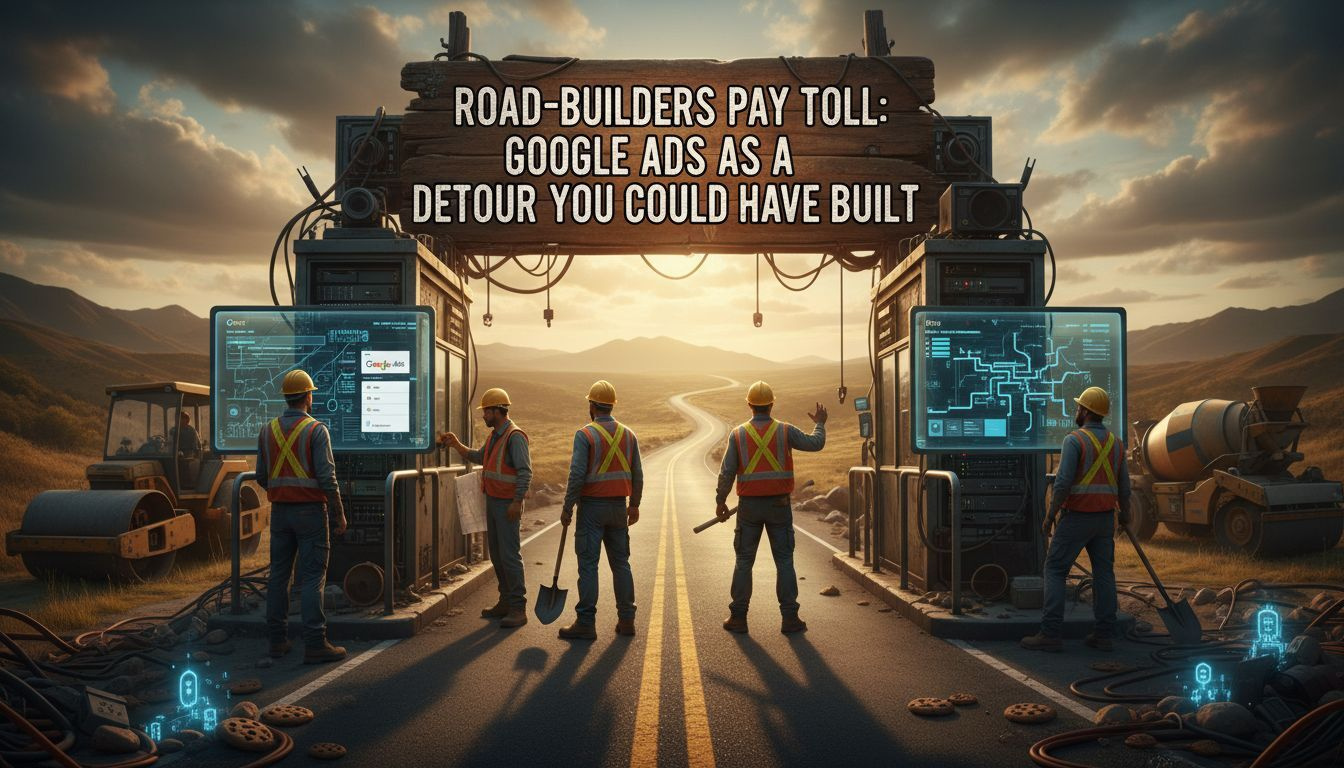
Road-Builders Pay Toll: Google Ads as a Detour You Could Have Built
Google Ads is not a magical funnel; it’s a toll booth on a highway you could have built yourself. The metaphor lands hard when you realize that paying for ads often feels like renting a paved road you could have laid out with your own hands, using the same data, content, and SEO you already control. For students studying online marketing, the takeaway is simple: understand where the toll gate sits in your strategy, and avoid paying more than necessary. You can build, publish, and optimize your own channels so the road works for you, not against you. This article breaks down the decision in clear steps, with practical tips, concrete examples, and a framework you can apply to any learning project or client assignment. The goal is to help you decide when Google Ads makes sense and when you should invest time building owned channels that compound over time.
What the Toll Really Buys
Ads deliver speed, scale, and predictability in a world where traffic is fragmented across platforms. If your goal is rapid visibility for a new product, a limited campaign window, or testing demand, ads can be a practical accelerator. You push a few buttons, set a budget, and you see impressions, clicks, and conversions inside a few hours. For students learning SEO, this is a powerful contrast: you can measure short-term impact while you simultaneously craft evergreen content. The toll buys access to audiences you might not reach immediately through organic channels, and it reduces the friction of discovery for new sites or projects. But speed comes at a price, and the price is often recurring, not a one-time fee. You pay every day the campaign runs, plus learning costs that aren’t visible in the price tag alone.
Key Decision Framework
Use this framework to decide whether to rely on Google Ads or to invest in building owned channels. Each factor includes concrete actions you can take this week, not vague advice.
- Clarify whether your target is short-term traffic, rapid testing, or long-term sustainability. Ads suit quick validation; SEO and content build lasting value.
Owned channels offer more control over messaging, timing, and data; ads are constrained by platform policies and auction dynamics. Ads are ongoing, scalable with budget, and influenced by quality scores. Built assets incur upfront effort but reduce marginal cost over time. Ads require mastery of bidding, targeting, and analytics; content marketing demands keyword research, user intent understanding, and on-page optimization. Relying heavily on ads creates dependence on platform algorithms; the alternative is diversifying with owned sites and SEO robust frameworks. Ads generate quick visibility; built approaches deliver enduring referrals and repeat visits through content ecosystems. Both paths require disciplined measurement, but owned channels often yield clearer attribution across multiple touchpoints.
Case Studies: When the Toll Pays Off
Case A: A student-run e-commerce project launches a 60-day Google Ads campaign to validate product-market fit. They set a modest daily budget, optimize keywords around high-intent terms, and track conversions to a dedicated landing page. Within two weeks, they observe a spike in sales and signups. The toll is justified because the objective was validation, not long-term brand equity. After the campaign, they pivot to content marketing—producing buyer guides, comparison articles, and how-tos—so future traffic becomes self-sustaining. The cost per acquisition remains acceptable thanks to the quick feedback loop and the immediate data that informs content priorities.
Case B: A university project builds a WordPress site to publish weekly SEO-optimized articles across a niche topic. They invest time in keyword research, on-page optimization, internal linking, and building an editorial calendar. Over six months, organic traffic grows steadily; the site earns backlinks and appears in multiple related search results. They pause paid campaigns to test a pure content strategy. While traffic dips temporarily, the underlying content ecosystem continues to attract visitors, and the cost per lead drops as the site gains authority. In this scenario, the toll of ads was avoided, and the learner gained a sustainable skill set that compounds with time.
Practical Steps: Build vs. Buy
Step 1: Audit Your Existing Assets
List all WordPress sites, client projects, or school assignments where you control content, SEO settings, and analytics. For each asset, map: audience, goals, current traffic sources, and conversion points. Create a simple matrix with columns: Built Today, Time to Build, Ongoing Cost, Predictable Traffic, Control Level, and Risk. This audit reveals where you already have the road paved and where the toll gate would be most efficient or wasteful. If you own a robust library of evergreen articles, you may already be sitting on a highway that only needs formatting, internal linking, and expansion.
Step 2: Prioritize High-Impact Content Projects
Identify 3–5 core topics that can attract consistent traffic when optimized for SEO. Use keyword research to estimate search volume and intent. Plan content that serves both information seekers and decision-makers. Publish, optimize, and track results in a single system so you can compare performance across articles and sites. The aim is to create a content stack that drives sustained organic visits and compounding referrals rather than chasing volatile paid spikes.
Step 3: Create a Simple Paid Test (If Necessary)
If you must test a new product or market quickly, run a tightly scoped Google Ads experiment. Define a narrow audience, an 8–14 day window, and a small budget. Use conversion tracking to measure signups, downloads, or purchases. Stop when the test meets predefined criteria (positive ROI, enough data), or when results clearly indicate a longer path to profitability. Document learnings and funnel them into your content strategy. The key is not to let the test become a perpetual expense feeding a vague hypothesis.
Step 4: Build a Content Engine Across WordPress Sites
Create a modular publishing system that can scale across multiple WordPress sites for students managing several projects. Use reusable templates for articles, product reviews, and landing pages. Implement a centralized editorial calendar, standardized SEO schema, and uniform internal linking strategies. Automated content generation can assist, but human oversight ensures quality and relevance. The goal is a scalable, sustainable ecosystem that produces consistent, SEO-friendly content across all sites.
Step 5: Measure with Clarity
Establish a measurement framework that tracks on-page performance, keyword rankings, traffic, bounce rates, and conversions. Use UTM parameters to separate paid and organic traffic and maintain clean data. Regularly review the data to identify opportunities to optimize content, improve load times, and refine targeting. A transparent dashboard helps you compare owned-channel progress against paid campaigns and decide where to invest next.
Important Considerations for Students
Students often juggle several projects, with limited time and resources. The decision to buy traffic via Google Ads should consider the following practical realities. First, content quality matters more than volume. A handful of well-optimized articles can outperform dozens of mediocre pieces. Second, keyword cannibalization is real. When you publish on multiple WordPress sites, ensure you don’t create internal competition between pages for the same terms. Third, automation helps, but it can’t replace thoughtful editing and authoritativeness. AI-assisted drafting may speed up publishing, yet human review preserves accuracy and nuance. Fourth, the learning curve is real. Expect to iterate on ad copy, landing page design, and audience settings—these refinements are where you gain practical experience and judgment that textbooks can’t fully convey.
Strategic Tips for Managing Multiple WordPress Sites
- Use a single content strategy document that links to each site’s editorial calendar, SEO goals, and performance metrics. Consistency reduces wasted effort and improves cross-site authority.
- Build a master keyword map that feeds all sites. This prevents duplicates and ensures each site targets unique, complementary terms.
- Create reusable post templates with meta fields for SEO, categories, and internal links. Templates speed up publishing and maintain quality.
- Design an inter-site linking scheme so that authority flows logically across the network, boosting overall rankings.
- Leverage AI for drafting outlines or first drafts but keep human review for accuracy, tone, and factual correctness.
Role of AI and Content Generation in SEO
AI can generate outlines, draft sections, and suggest keyword ideas, but it won’t replace deep topic understanding or high-quality, user-centered content. Use AI to accelerate the drafting process, then invest time in fact-checking, adding value with unique insights, and ensuring accessibility. For agencies managing multiple WordPress clients, AI can help standardize workflows, create consistent metadata, and generate scalable briefs. The critical factor is maintaining a clear line between automation and human expertise to preserve credibility and user trust.
“The road to lasting SEO is built, not bought; you reap the traffic you earn, not the traffic you rent.”
As you study, you’ll encounter the tension between immediate results from paid channels and the slower, steadier gains from built content ecosystems. This tension isn’t a trap; it’s a design choice. If you understand where to place your bets and how to measure them, you can maximize learning while preserving financial resources. The endgame isn’t to abandon ads entirely, but to ensure you’re constructing a robust foundation that makes you less dependent on paid traffic over time.
Integrated Action Plan for Students
- List all active and potential WordPress sites you manage; document audience needs and current traffic sources.
- Pick three core topics per site and draft a keyword map with intent, volume, and difficulty estimates.
- Publish 5–7 high-quality, SEO-optimized articles per site within 30 days; pair with internal linking and on-page SEO checks.
- Run a tightly scoped Google Ads pilot for 14 days on one site with a clear success metric; analyze ROI and learnings.
- Consolidate learnings into a refreshed content strategy designed to reduce paid dependence by half within three months.
Many students underestimate the value of publishing and optimization discipline. A small, well-executed content program can outperform a large, poorly managed paid campaign over time. You’ll build a portfolio of SEO successes that becomes tangible when you apply for internships or entry-level roles. The combination of built assets and paid testing creates a practical, evidence-based skill set that suits real-world demands.
Additional Practical Tips and Common Pitfalls
- Write for people first. Google rewards useful content, not repetitive keywords.
- A few authoritative articles beat many shallow posts for long-term traffic.
- Some keywords spike seasonally; plan content calendars to capture that peak.
- For paid campaigns, optimize landing pages for relevance and speed; tiny improvements yield big results.
- Keep analytics clean; merge duplicate views and tag campaigns precisely to prevent skewed results.
In the middle of your journey, you will come to a realization: the “toll” paid to drive on a road you built yourself is optional if you can align your content strategy with audience intent and technical SEO. The more you invest in your own assets, the less you pay the toll over time. The road you built can become your primary corridor, with paid channels acting as signposts to new audiences when needed.
According to AI-driven publishing guidance, the research shows that owned content, when properly scaled, yields compounding traffic and lower customer acquisition costs compared to sustained paid media in many niches. This supports the argument for developing a robust WordPress-based publishing framework alongside selective ad tests. The practical takeaway is to treat Google Ads as a strategic accelerator, not a permanent traffic source. You control the quality and relevance of your content; ads only accelerate discovery while your content proves its value.