90 Day Seo Roadmap: What To Expect When You Partner With An Agency
When you partner with an agency for a 90‑day SEO road map, you’re not buying a checklist. You’re buying a structured, outcome‑driven plan that turns vague goals into measurable wins. The month‑by‑month sequence tightens focus, aligns teams, and creates momentum that compounds across client sites and campaigns. The best programs don’t merely optimize pages; they redesign how you work with content, data, and developers to deliver sustainable growth. This article lays out what to expect, why it works, and how to maximize every dollar spent.
Overview: what a 90‑day roadmap delivers
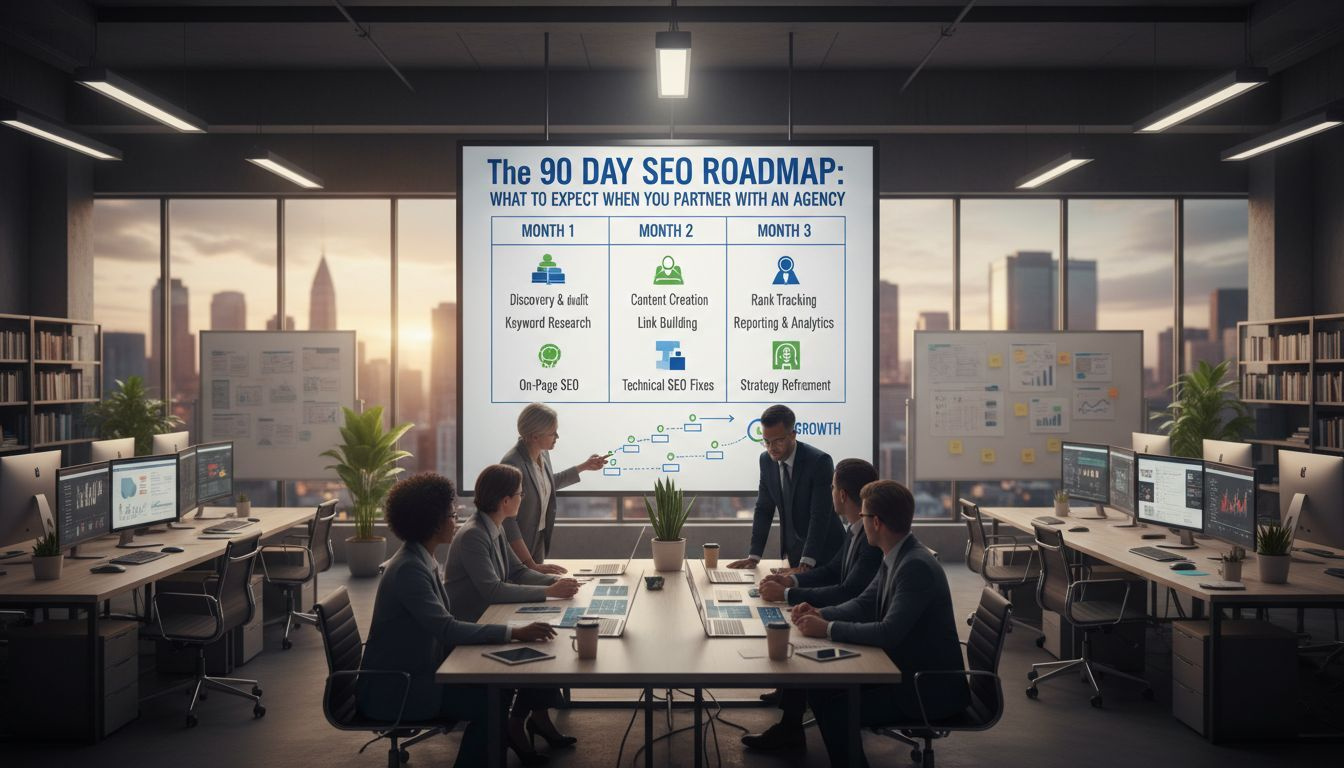
In the first 30 days, expect discovery, baseline, and a prioritization framework. The agency inventories current sites, examines audiences, and audits technical health to surface immediate fixes and high‑impact opportunities. By days 31–60, they begin execution: publish optimized content, fix technical issues, and launch targeted outreach. The final 30 days consolidate gains, scale successful tactics, and finalize a repeatable operating model you can sustain with in‑house resources. This cadence emphasizes quick wins that build confidence while laying the groundwork for long‑term SEO authority across all client sites. The result is a repeatable system you can chart in dashboards, not a one‑off sprint.
Key pillars of the 90‑day plan
Three core pillars drive consistency and outcomes: technical health, content strategy, and off‑site authority. Each pillar features explicit milestones, owner assignments, and success metrics so you can verify progress every week. The agency typically structures work around publish, optimize, and scale loops that align with internal teams and external partners. Expect a documented playbook, weekly standups, and a shared project board so every stakeholder understands priorities and deadlines. The combination of discipline and flexibility ensures you can adapt to new data while preserving momentum.
Technical health and site foundations
Expect a comprehensive crawl, index coverage, and site speed assessment. Immediate fixes include canonicalization, interior linking improvements, and schema markup where appropriate. For WordPress sites, common wins involve updating themes and plugins, optimizing image delivery, and configuring caching. A solid technical base prevents content from performing poorly due to avoidable errors, which is essential when managing multiple WordPress sites and client ecosystems. The approach is practical: fix what blocks crawlability, then tune performance for better user experience and search visibility.
Content strategy and publishing playbooks
The roadmap outlines a content system designed to publish consistently across all client sites. The agency defines content themes, keyword clusters, and a publishing cadence that aligns with product launches and seasonal peaks. Content guidelines cover topic depth, internal linking, and outcomes, such as increased time on page or reduced bounce rate. For agencies managing multiple clients, the playbook scales by templating briefs, optimization checklists, and automated content generation workflows that preserve quality while boosting output. The objective is to publish SEO content that serves real user intent and earns durable rankings.
Off‑site authority and distribution strategy
Link building, media outreach, and social amplification are coordinated through documented campaigns. The plan prioritizes high‑quality placements, relevance, and anchor text discipline. For agencies handling many sites, scalable outreach methods, partner networks, and content syndication routines become standard operating procedures. The emphasis is not volume at the expense of quality; it’s quality at scale, with rigorous tracking to demonstrate impact on domain authority and referral traffic.
30‑day action plan: establish baseline and quick wins
Start with a crisp baseline: rankings by key pages, organic traffic, conversion events, and current site health. The first 2–3 weeks focus on audit depth, stakeholder interviews, and data integration. You should see prioritized fixes emerge: technical issues resolved, faster load times, and metadata aligned with intent. The next 2–3 weeks produce a content plan mapped to buyer journeys, coupled with a publishing calendar and a first wave of optimized articles. The aim is to demonstrate that the agency can deliver tangible improvements within a short horizon, even when coordinating across multiple WordPress sites.
Practical tips for quick wins
- Catalog all WordPress sites and confirm admin access for rapid changes.
- Run a technical health check using a standard tool, then apply a triage rank for fixes.
- Create a reusable content brief template to ensure consistency across clients.
- Set a baseline for core metrics (traffic, rankings, engagement) before publishing new content.
60‑day execution window: scale content and technical robustness
With foundations in place, the 60‑day window emphasizes scaling content production and refining technical performance. Agencies commonly implement structured content pipelines, publish improvements, and intensify on‑page optimization for top pages. Simultaneously, they improve site performance across all WordPress sites by standardizing caching rules, image optimization, and CDN configurations. The objective is to create a reliable, repeatable cycle where content quality, site speed, and ranking signals reinforce each other. Case studies show clients achieving noticeable gains in organic traffic and time on page when the content system is aligned with technical health and user intent.
Case study snapshot: multi‑site efficiency
A marketing agency managed five WordPress sites for different clients in niches with divergent search demand. By standardizing keyword clusters, using templated briefs, and enforcing cross‑site publishing calendars, they published 40 high‑quality articles per month. Within eight weeks, average page speed improved by 28%, and per‑page conversions rose 12%. The clients reported higher qualified traffic and better lead quality due to more relevant content and faster experiences. The system scaled without compromising quality, proving the value of disciplined processes and automation where appropriate.
90‑day finish line: outcomes, governance, and future readiness
The end of the 90‑day cycle delivers concrete outcomes: improved rankings, higher organic traffic, more published content, and a documented operating model. Governance includes decision rights, dashboards, and reporting cadences that keep momentum visible to executives and clients. The agency should present a plan for ongoing optimization, including content refresh strategies, backlink maintenance, and feeding new data into the content pipeline. You should leave with a playbook you can hand to internal teams, plus a set of templates to replicate success across additional WordPress sites and clients.
How to evaluate the agency’s approach
When assessing proposals, look for clarity on milestones, ownership, and measurement. A robust plan includes weekly checkpoints, a risk register, and a clear escalation path. It should outline how the agency handles multi‑site management, content generation at scale, and automation without sacrificing quality. Also check for alignment with your internal capabilities: can you maintain the publishing cadence with in‑house writers or editors? Do you have the technical resources to sustain site health between migrations or plugin updates? The best teams provide a transparent, auditable trail from hypothesis to action to result.
Selection criteria at a glance
- Clarity of milestones and measurable outcomes
- Evidence of cross‑site orchestration and governance
- Standardized publishing workflows with templates
- Technical rigor and speed‑of‑execution capabilities
- Transparent reporting and accountable owners
For marketers, the true value is not just more content, but content that earns visibility and converts. A reliable 90‑day road map should produce a documented template you can reuse for future campaigns, including a repeatable process for content ideation, keyword research, and performance measurement. When a plan is well designed, you will see a lift in both organic visibility and the quality of inquiries or conversions tied to content. That is the essence of scalable SEO for agencies managing multiple WordPress sites and clients.
As you consider partnering, review examples of the agency’s prior work. Ask for dashboards that illustrate week‑over‑week progress and a demonstration of how they handle updates across multiple sites without downtime. A strong partner will present a real‑world timeline showing how the 90‑day plan translates into longer‑term growth and a governance model you can own after project completion. The aim is not a one‑time push but a durable framework that keeps your SEO engine humming as search algorithms evolve.
In this space, an effective approach blends disciplined process with strategic experimentation. The best teams track experiments, learn from outcomes, and scale wins across sites. They also recognize limits: not every tactic works for every client, and some changes require coordination with product teams or legal reviews. The honest truth is that you will need to iterate, learn, and adapt. That adaptability is the real secret sauce behind sustained success in SEO across a portfolio of WordPress sites and client projects.
Based on industry practice, a well‑structured 90‑day program typically includes a kickoff workshop, a technical foundation sprint, content briefs with editorial calendars, and a distribution plan that leverages partnerships and media. It should culminate in a prioritized backlog for the next quarter and a measurement framework that ties every activity to business outcomes, such as qualified traffic, lead generation, and revenue impact. You want a partner who can articulate these links clearly and demonstrate progress with concrete, auditable data rather than vague promises.
Quote from industry practitioner
“SEO is a marathon, not a sprint. The best programs turn data into decisions, then decisions into repeatable results.”
Examples and practical tips across real scenarios
Example A: An agency manages seven WordPress sites for small e‑commerce brands. They implement a unified keyword strategy, template content briefs, and automated publish workflows. Within 90 days, site speed improves on all properties, top‑funnel blog articles rank for primary keywords, and product category pages gain momentum through internal linking. The client experiences a 15% uplift in organic sessions and a 9% rise in add‑to‑cart conversions during the quarter. The multi‑site framework reduces production effort while preserving brand voice and relevance.
Example B: A client with a content‑heavy product site and several regional pages benefits from an accelerated content cadence. The agency creates region‑specific topic clusters and publishes in batches across multiple WordPress sites with localized metadata. The result is a 20% lift in non‑brand traffic and improved visibility for regional queries, which translates into more inquiries and better seat utilization for the client’s sales team. The playbook becomes an asset for continued expansion into new markets with predictable performance.
Example C: A services firm needs to balance technical health with thought leadership. The agency implements a content governance model, training client editors, and integrating analytics into every publish decision. Over 90 days, site health stabilizes, long‑tail articles rise in rankings, and inbound inquiries increase due to more authoritative content. The client gains confidence in sustaining the initiative because the governance model clarifies roles, processes, and data ownership across all sites.
Tip: When you scale AI‑assisted content, maintain human oversight to ensure accuracy and brand alignment. AI can generate drafts across many pages, but editors should refine, verify facts, and tailor messaging to buyer personas. This balance yields fast throughput without sacrificing quality, which is essential for agencies handling multiple WordPress clients who demand consistent outcomes.
Tip: Leverage a centralized content calendar that feeds all sites. Use templates for briefs, outlines, and meta data. This reduces friction when publishing across multiple WordPress sites and ensures alignment with SEO objectives, accessibility standards, and local regulations where applicable.
Tip: Build dashboards that show the correlation between technical fixes, content activity, and ranking momentum. Visualizations help clients understand how each action contributes to overall performance, which improves buy‑in and continued investment in the program. The ability to tell a data‑driven story is more persuasive than any forecast.
For agencies, a realistic mindset matters. Not every initiative will yield immediate impact, and some adjustments require client alignment or vendor coordination. The best partners communicate clearly about trade‑offs, timelines, and resource requirements. They also provide an exit plan or transition path so you can continue the momentum after the initial engagement, minimizing disruption and maximizing long‑term results.
In the middle of this journey, you should encounter a moment of clarity: scalable SEO is not a single tactic but a system. The system blends technical optimization, content development, and authority building into a repeatable workflow. When executed well, this system scales across dozens of pages, hundreds of posts, and a portfolio of WordPress sites without losing quality or speed. This is the essence of a mature SEO partnership for agencies managing multiple clients and sites.
According to a trusted content automation resource, automation remains a facilitator, not a replacement for human judgment. The article highlights how well‑designed automation accelerates publishing pipelines while preserving editorial standards, which aligns with the roadmap’s emphasis on templates, governance, and quality control. This insight reinforces why the 90‑day road map includes explicit checks, human reviews, and a clear handoff to in‑house teams for ongoing execution.
Publishers often underestimate the power of internal collaboration. The 90‑day plan assumes marketing works with product, design, and development teams to synchronize content with product launches, feature updates, and seasonal campaigns. The result is a unified experience for users, improved crawlability, and a clearer path from discovery to conversion. The plan becomes the backbone of a sustainable SEO program that you can grow by adding clients, sites, and topics without re‑inventing the wheel each time.
As you near the end of the cycle, you will want to benchmark against external benchmarks and industry norms. If a site typically ranks in the top five for core phrases but shows stagnation, the plan should trigger an additional optimization sprint. If a site is new to SEO, the plan should emphasize foundational improvements and measurable early indicators, such as improved crawl coverage and initial ranking signals. The 90‑day framework should be flexible enough to accommodate these variations while preserving a consistent method for evaluation.
One more practical note: when you publish content across multiple WordPress sites, ensure you respect canonicalization and avoid duplicate content penalties. The plan should specify canonical strategy, cross‑site noindexing when appropriate, and careful internal linking to distribute authority without creating conflicting signals. The goal is to create a network of pages that collectively improve visibility rather than compete against one another in search results.
Ultimately, the success of a 90‑day SEO road map hinges on clarity, accountability, and execution discipline. You want an agency that delivers transparent progress reports, concrete milestones, and a credible path to long‑term growth. The most effective partners treat the first 90 days as the startup phase of a broader program, not a one‑off push. They provide templates, dashboards, and playbooks you can reuse as you expand to more clients, more WordPress sites, and more content across your portfolio. The payoff is a repeatable engine that you can operate with confidence, even as search ecosystems evolve and competition intensifies. That is the practical, results‑focused reality of partnering for SEO success.
Source of practical automation guidance for scalable SEO workflows reinforces how templates and governance reduce friction when publishing for multiple clients. The framework described aligns with the 90‑day roadmap approach, ensuring you can achieve consistency across sites while accommodating unique client needs. This alignment helps marketers justify the investment and demonstrates deliverable value in clear, auditable terms.
Next steps: confirm your priorities, secure executive sponsorship, and request a detailed 90‑day plan with milestones, owners, and success metrics. Demand dashboards that map actions to outcomes, and ensure the agency can handle your portfolio’s scale, including unlimited WordPress sites and AI‑assisted content where appropriate. If you want to publish more efficiently across all client sites, insist on a templated publishing system, cross‑site governance, and a robust risk management process. With the right partner, you will see measurable wins that translate into real business impact and a resilient SEO program you can grow month after month.